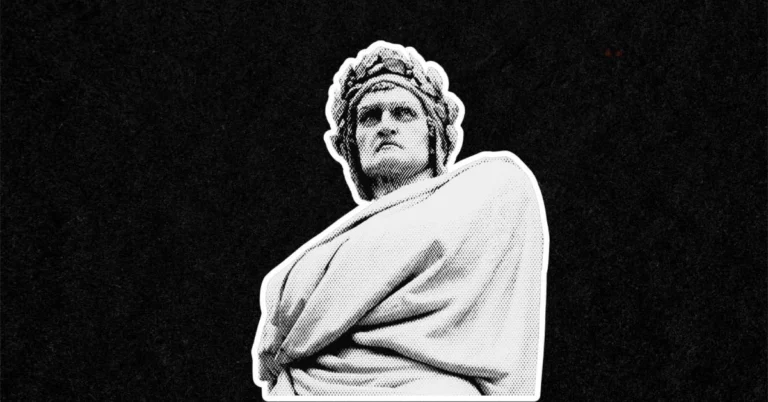
In the preface to Inferno (1976), co-authored with Larry Niven, Jerry Pournelle described himself as “a 14th-century liberal.” The phrase, seemingly paradoxical, reflected his Catholic faith and conservative worldview, deeply rooted in the moral and political sensibilities of medieval Christendom, particularly the era of Dante Alighieri, while deliberately distancing himself from the modern liberalism of …
In the preface to Inferno (1976), co-authored with Larry Niven, Jerry Pournelle described himself as “a 14th-century liberal.” The phrase, seemingly paradoxical, reflected his Catholic faith and conservative worldview, deeply rooted in the moral and political sensibilities of medieval Christendom, particularly the era of Dante Alighieri, while deliberately distancing himself from the modern liberalism of the twentieth century. As reviewer Norman Spinrad observed, and as later analyses such as Mary Pat’s comparison of Dante’s Inferno to Pournelle and Niven’s science fiction adaptation have noted, this self-description was more than an eccentric remark: it was an assertion of moral order, hierarchy, and responsibility against the relativism and secularism of the modern age. Yet Pournelle’s phrase invites a deeper question. What, indeed, would it mean to be a “liberal” in the fourteenth century—a period long before liberalism, democracy, or constitutional rights as we understand them existed? Could such a term even apply to an age still defined by feudal bonds, ecclesiastical authority, and scholastic theology?
To explore that question is to uncover the intellectual currents that prefigured the later emergence of liberal thought: ideas of individual conscience, the limitation of authority, and the moral worth of reason that began to take form amid the conflicts of Church and state, faith and philosophy. Thinkers such as William of Ockham and Marsilius of Padua articulated visions of political legitimacy rooted not in divine right but in consent, law, and the autonomy of human reason. Early humanists, such as Petrarch, rediscovered classical ideals of civic virtue and moral agency, laying the cultural groundwork for the later rise of Renaissance individualism. Even the legal and parliamentary developments of late medieval England hinted at the rule of law and representation, the seeds from which modern constitutionalism would eventually grow.
Thus, to understand what Pournelle meant by calling himself a “14th-century liberal” is to recover a lost genealogy of political thought, a period when “liberal” could not yet mean “progressive,” but rather signified an appeal to the freedom of the soul, the dignity of conscience, and the governance of reason. This essay will examine the historical and philosophical substance behind that phrase by tracing the proto-liberal currents of the fourteenth century: the intellectual revolutions of nominalism, the conciliarist challenge to ecclesiastical absolutism, the rise of civic humanism, and the gradual assertion of law over power. Through these developments, we can discern the first contours of a worldview that, centuries later, would evolve into what we now recognize as liberalism.
The Anachronism of Liberalism
The very notion of a “14th-century liberal” appears, at first glance, an anachronism. The 1300s were an age of hierarchy, not equality, a world in which the cosmos, the Church, and the political order were conceived as reflections of a divinely ordained structure. The medieval imagination was not yet attuned to the idea of the autonomous individual as a bearer of natural rights. Instead, it conceived of man primarily as a member of a community (spiritual, political, or familial) bound by duties rather than endowed with liberties.
Yet the fourteenth century was also a time of intense crisis and transformation. Secular rulers challenged the papal monarchy; the Black Death and economic upheavals undermined feudal relations; the Great Schism shattered the unity of Christendom; and universities became laboratories for new modes of reasoning. Out of this turbulence arose thinkers who, often unintentionally, began to lay the foundations for a new conception of the human person and of political legitimacy. The idea of libertas, freedom, was still framed in moral and spiritual terms. Still, it began to take on social and political dimensions as the relationship between ruler, subject, and law was reconsidered.
The term “liberal” itself, in the medieval lexicon, referred not to political ideology but to the liberal arts—the disciplines that freed the mind from ignorance. Yet this linguistic root is telling: liberalitas meant the cultivation of the intellect and the exercise of reason, the very capacities that later liberalism would elevate as the basis of human dignity. In this sense, the intellectual movements of the fourteenth century can be seen as the early stirrings of a liberal spirit: a turn toward reason, conscience, and human agency as sources of moral and political order.
Nominalism and the Individual: William of Ockham
One of the most significant figures in this intellectual transformation was William of Ockham (c.1287–1347). A Franciscan friar, philosopher, and theologian, Ockham is remembered primarily for his nominalist epistemology, which denies the real existence of universals apart from individual things. To Ockham, universals were merely names (nomina), useful mental constructs, but not realities in themselves. The only true realities were individual entities.
This philosophical move had profound political and theological consequences. By denying the objective existence of universals, Ockham implicitly undermined the metaphysical basis of corporate entities such as “the Church” or “the Empire,” which had been understood as mystical bodies possessing their own reality and authority. In their place, he emphasized the primacy of individual persons, whether as believers or citizens. The Church, for Ockham, was not an ontological unity but a community of believers, and its authority rested on the consent of those individuals, not on divine fiat mediated through the Pope.
Ockham’s political writings, especially Breviloquium de principatu tyrannico and Dialogus, further developed this idea. He argued for the limits of papal authority, insisting that secular rulers possessed independent legitimacy derived from natural law and the consent of the governed. He maintained that no one should be compelled to act against the dictates of conscience, an early articulation of the freedom of conscience that would later become a cornerstone of liberal thought.
Ockham’s insistence on the autonomy of secular power and individual conscience marks one of the earliest philosophical assertions of what might be called a “proto-liberal” anthropology. His thought dissolved the monolithic unity of medieval authority, opening the way for a conception of politics grounded in the individual, rather than in an organic or divine hierarchy.
III. Conciliarism and the Origins of Constitutional Thought
If Ockham’s nominalism provided the philosophical basis for individual autonomy, Conciliarism supplied its political counterpart. The Conciliarist movement emerged in the early fourteenth century as a response to the papal claims of absolutism and the crises of the Avignon Papacy and the Great Schism. Its central idea was that the authority of the Church resides not solely in the Pope but in the community of the faithful, represented by councils.
The most important thinker in this tradition was Marsilius of Padua (c.1275–1342), author of Defensor Pacis (1324). Marsilius argued that the trustworthy source of political authority is the people (universitas civium), who collectively possess the power to establish laws and choose rulers. The Church, he claimed, should have no coercive power in temporal affairs; its role is purely spiritual, and its governance should be subject to general councils rather than papal autocracy. Marsilius’s vision of the state was one of secular law, popular consent, and limited clerical authority, ideas that anticipate the constitutionalism of later centuries. “The legislator or the first and proper efficient cause of law is the people or the whole body of citizens,” Marsilius of Padua, Defensor Pacis, I.12.
Marsilius’s notion of a community of citizens collectively forming the legislator foreshadows the sovereignty of the people articulated by thinkers like Locke and Rousseau. While his “people” were not the democratic masses of the modern era, but the corporate citizenry of a medieval polity, his insistence that legitimate power arises from human consent rather than divine right represents a decisive break from medieval hierocracy.
John of Paris (Jean Quidort, d.1306) likewise advanced the principle that both papal and royal authority are limited by natural and divine law, and that secular government enjoys legitimate independence from ecclesiastical control. Together, Marsilius, Ockham, and the Conciliarists developed the intellectual tools that would later enable political theorists to challenge absolutism and assert the supremacy of law and representation.
The Early Humanist Turn: Petrarch and the Dignity of Man
By the late fourteenth century, a parallel transformation was underway in Italy: the Renaissance humanist revival. Figures such as Francesco Petrarca (Petrarch) (1304–1374) turned to the study of classical antiquity, not merely as a literary or scholarly pursuit, but as a moral and civic one. Humanism emphasized the capacities of reason, virtue, and self-cultivation. In contrast to the medieval focus on divine transcendence, the humanists celebrated the potential of the individual to achieve excellence within the earthly realm.
Petrarch’s writings, while still profoundly Christian, reoriented moral thought around the inner life and moral autonomy of the person. His famous Secretum dramatized the conflict between faith and reason, duty and desire—marking the birth of the introspective self that would later occupy the center of liberal individualism. Moreover, Petrarch’s civic ideals, inspired by the Roman Republic, exalted active citizenship and the pursuit of virtue in public life.
This humanistic anthropology subtly redefined liberty: not merely the absence of constraint, but the cultivation of self-rule through reason and education. The “liberal” man was thus one who exercised freedom through moral and intellectual mastery. This conception would, centuries later, evolve into the liberal emphasis on education, autonomy, and the dignity of the person.
The Legal Foundations of Liberty: Law and Representation
While these intellectual shifts were taking place, institutional developments in medieval Europe, especially in England, were laying the groundwork for modern constitutional liberty. The Magna Carta (1215) had already established the principle that the king was subject to the law, and not above it. By the fourteenth century, the English Parliament had become an established institution, embodying the principle that taxation and legislation required the consent of the governed—even if that “governed” class was limited to nobles and landholders.
These developments reflected a growing conviction that law derives its legitimacy from consent and serves as a limit to arbitrary power. The emergence of representative assemblies across Europe, such as the Cortes in Spain, the Estates in France, and the diets in the Holy Roman Empire, signaled the gradual institutionalization of this principle. Although these were not liberal democracies, they embodied the embryonic idea of government by consent, which would become a hallmark of liberal political philosophy.
In this sense, the fourteenth century represents the constitutional adolescence of Europe: an era in which the vocabulary of liberty, law, and representation began to detach itself from purely theological roots and take on a secular political meaning.
The Meaning of a “14th-Century Liberal.”
To be a “14th-century liberal,” then, would not mean advocating for parliamentary democracy or free markets. Instead, it would entail a commitment to reason, conscience, and law as checks on arbitrary power, whether that power was exercised by kings or by popes. It would involve a belief in the moral dignity of the individual and in the idea that legitimate authority must rest on consent and justice, not on divine prerogative.
Such a figure might stand with Marsilius of Padua in defense of the community’s right to make its own laws; with William of Ockham in defense of the freedom of conscience; and with Petrarch in the conviction that human reason and virtue are the proper foundations of moral life. He would oppose tyranny, whether temporal or spiritual, while affirming a world ordered by moral law rather than brute power.
Pournelle’s self-description, in this light, becomes intelligible: the “14th-century liberal” was not a progressive, but a moral realist, one who sought liberty within the framework of order, faith, and rational law. It was an affirmation of the ancient and medieval conception of freedom—not as license, but as the disciplined exercise of reason in harmony with the good.
VII. From Medieval Liberalism to the Modern Age
The ideas that emerged in the fourteenth century would not bear fruit until centuries later. Yet the genealogy of modern liberalism can be traced directly through this lineage. Ockham’s nominalism prefigured the individualism of the Reformation; Marsilius’s theory of consent anticipated the social contract; Petrarch’s humanism paved the way for Renaissance selfhood; and the parliamentary experiments of England foreshadowed constitutional government.
By the seventeenth century, these dispersed strands converged in the works of John Locke, Hugo Grotius, and Thomas Hobbes, who formalized the liberal doctrines of natural rights, contractual government, and the rule of law. What had begun as theological and philosophical disputes within medieval Christendom evolved into a secular political philosophy that redefined liberty in universal terms.
Yet the medieval roots of liberalism remind us that its deepest impulses were not revolutionary but reformative—an attempt to reconcile human freedom with moral order, reason with faith, and law with conscience. In that sense, the “14th-century liberal” represents not the negation of the medieval world, but its most enlightened expression.
Conclusion
To ask what a “14th-century liberal” would be is to recognize that liberalism, as both an idea and a disposition, has a longer and more complex genealogy than modern history often admits. Long before Locke and Mill, before the Enlightenment and the revolutions, some thinkers insisted that authority must answer to reason, that conscience cannot be coerced. That law must serve justice rather than power. In Ockham’s defense of individual conscience, Marsilius’s theory of popular sovereignty, and Petrarch’s celebration of human dignity, we find the first stirrings of a tradition that would one day call itself liberal.
Jerry Pournelle’s self-description as a “14th-century liberal” thus captures a paradox that is both moral and historical: the conviction that true liberty is not the emancipation from order, but the flourishing of the human person within it. The 14th-century liberal stood at the threshold of modernity, gazing forward from the world of faith toward the world of reason, asserting, even in an age of hierarchy, that the human mind and conscience are free.
Join the Club
Like this story? You’ll love our monthly newsletter.
Thank you for subscribing to the newsletter.
Oops. Something went wrong. Please try again later.