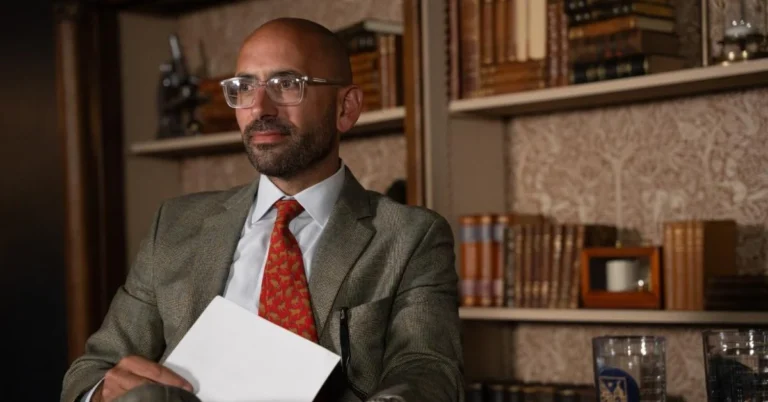
Alex Priou received a Ph.D. and M.A. in Philosophy from Tulane University, an M.A. in Liberal Arts from St. John’s College, and a B.A. in Political Science from the University of Connecticut. Priou is the author of three books on Plato: "Becoming Socrates: Political Philosophy in Plato’s Parmenides" (2018), "Defending Socrates: Political Philosophy Before the Tribunal …
Alex Priou received a Ph.D. and M.A. in Philosophy from Tulane University, an M.A. in Liberal Arts from St. John’s College, and a B.A. in Political Science from the University of Connecticut.
Priou is the author of three books on Plato: “Becoming Socrates: Political Philosophy in Plato’s Parmenides” (2018), “Defending Socrates: Political Philosophy Before the Tribunal of Science” (2023), and “Musings on Plato’s ‘Symposium'” (2023). He has also written essays on the history of philosophy for various journals and edited volumes in Classics, Philosophy, Political Science, Literature, and Film, including studies of Homer, Hesiod, Parmenides, Plato, Aristotle, and beyond. He also engages in public scholarship, occasionally writing for a general audience, but most frequently with The New Thinkery, a weekly podcast he co-hosts with his two close friends, Gregory McBrayer and David Bahr. Together, they aim to model friendly and fun conversations between friends on texts and topics in the history of philosophy.
Priou is currently working on a book on Plato’s Republic that will offer a comprehensive overview of its drama, situating the characters, with all their hopes, opinions, and commitments, in the context of the political events that have shaped them. He hopes to show how Socrates’ investigation of the good life amid the political and moral decline of imperial Athens can serve as a model for us today, confronted as we are by similar circumstances. After that, he plans to resume work on a non-historical study of the nature of civilization and barbarism intended for a more general, educated audience.
Image of Dr. Alex Priou courtesy of Stephen Plodinec of the University of Austin, TX
What follows is an interview conducted by Aleksandar Todorovski, editor-in-chief of Miskatonian.com, with Dr. Alex Priou.
Aleks – Your journey from the disciplined environment of St. John’s College to the uncertain adjunct positions at Sarah Lawrence and Long Island University, before settling at the University of Austin, reflects a modern exile within academia’s margins. Is life in contemporary academia an archetypal tragedy or a redemptive arc? I believe this is an excellent starting point to give you the floor to one of the best-dressed professors of political philosophy I have met, who can easily be mistaken for a John Wick film’s sensual and erudite antagonist.
Dr. Priou – Thank you for what I take to be a compliment—I’ve not seen the John Wick franchise—and for sending along a series of interesting and provocative questions. Responding to them has been a challenge and a pleasure.
Tragedy and redemption are too high-minded for careerist concerns, and my situation after grad school, a little over a decade ago, was similar to many—too many PhDs, too few jobs, hence a string of adjunct and visiting positions. The relevant thing is that in the hinterlands of the academy, one either breeds resentment or hones one’s skills. I tried as best I could to do the latter. It has shored up my confidence that, though the ground fell out from under me after graduate school, it feels much more solid beneath me today—confidence in myself, yes, but confidence much more that circumstances increasingly favor right-minded people.
Aleks – Plato first captivated you with the dramatic play of his dialogues, turning political philosophy from abstract theory into a real confrontation with the human condition. What hidden impulse initially pulled you into the vast world of classical philosophy?
Dr. Priou – Initial impulses are hard to assess. When I was young, I had heard of a series of books casually referred to as five feet of the greatest works. Now I know it was a reference to the Harvard Classics. But even then, it struck me as totally reasonable that the heights of human intellectual achievement could fit onto a single shelf, maybe two if one wants to be charitable (or if one’s bookcase is svelte). I imagine that had something to do with it. All I can say with confidence is that when I read in Strauss that the great thinkers may have hidden their deepest thought from lesser minds, it struck me as both wholly reasonable and deeply enticing.
Aleks – In Becoming Socrates, you trace the philosopher’s genesis from the poetic and Pre-Socratic mists of Homer and Hesiod, positioning him as a bulwark against both epistemic and general primordial chaos. How did these archaic specters of myth and early inquiry compel you to center Plato in your scholarship, rather than consign him to the dust of antiquarian curiosity while pursuing novelty and new breakthroughs with your deliberations?
Dr. Priou – That book, a revised version of my dissertation, was an attempt to understand why political philosophy might be, or rather is, first philosophy. Straussians say this a lot, but I didn’t really see anyone showing how political questions are at play, even in the ontological or metaphysical works of the classics. Only Seth Benardete seemed to be doing that, but since he had passed away, I went to Tulane University to study with his student, Ronna Burger. Naturally, for my dissertation, I looked to the young Socrates to see why he turned to the human things, to political philosophy. I had initially planned to write on Plato’s Parmenides and the relevant passages of the Symposium and Phaedo, but gradually it became clear to me that the Parmenides itself was the dialogue on the so-called Socratic turn—I explain all this in the book. But to your question regarding Homer and Hesiod, it was seeing the aged Parmenides guide the young Socrates to political philosophy that drove me to turn to the pre-Socratic philosophers and poets, first to the fragments of Parmenides and Heraclitus, and then as a result of Heraclitus also to the works of Hesiod and Homer. What I came to see was that these men were all concerned with a similar problem, having to do with divine providence and divine law. So, in a way, the situation was the reverse of what I think you imply with your question: I only took Homer and Hesiod seriously, the poets seriously, because Plato had shown me I had to.
Aleks – Socrates’ method, with its ironic probes and feigned ignorance, promises liberation from dogmatic slumber but often leads to existential vertigo. Where do you see his influence most ominously in today’s discourse, including the ethical voids of AI-driven decisions or the fractured debates of identity politics on different spectrums that masquerade as quests for justice?
Dr. Priou – So long as man remains such as he is, Socrates will be the undeniable peak of human excellence. That’s my guess, at least. There are valiant attempts to beat him at his game, but the talk of spectrums, to use your example, is typical and typically weak. Consider Foucault, the exemplar here. A sympathetic and thoughtful study of, on one hand, his premises, as we find them in “Nietzsche, Genealogy, History,” and, on the other, their application in his historiographical, sociological, or anthropological works (however you wish to classify them) reveals an inconsistency. Foucault attempts to reduce everything to power—that’s the crude Nietzscheanism. But whenever he explores this or that phenomenon, he finds his analysis beholden to certain conceptual necessities or, let’s be bolder, formal necessities, that is, inherent structures in human relations. The door is opened to a formal analysis of human things, in all times and places—in short, to Socratism. Foucault tries to slam shut in his methodological work the very door he opens in his historical works. Socrates agrees with Foucault in that he recognizes how much of our thought is owed to power, but he differs in not ceding one iota more than he has to—that’s why he’s a philosopher, and Foucault isn’t.
Aleks – The left’s fascination with Plato, you might argue, stems from a selective “hermeneutics of surface” that overlooks his deeper esoteric layers and defenses of hierarchy. How has this shallow parasitism distorted progressive ideals, turning discussions of virtue into monologues of power?
Dr. Priou – Seth Benardete once wrote, “What philosophy is seems to be inseparable from the question of how to read Plato.” To put this more crudely: every ideology needs to give an interpretation of the past, according to which it and nothing else, no one else, is the peak of human intellectual achievement. A reading of any philosopher that holds open the possibility that the peak may have been in the past is totally destructive of modern ideals, progressive, liberal, or even nationalist. To put a sharper point on this, a non-doctrinal reading of Plato, the father of philosophy, immediately puts on the defensive every doctrinal thinker, which includes all modern ideological thought. They are put in the awkward, if not also impossible, position of arguing that their solutions are so definitive as to expose the questions they answer or problems they solve to be fundamentally misguided. Open contemplation of the problems would, on this account, be a philosophic error, which seems totally indefensible. Of course, the greatest modern philosophers are aware of this difficulty.
Aleks – Plato’s notion of the cave, which includes subjects like prisoners chained to illusions, mistaking shadows for reality, resonates as a metaphor for technological entrapment. In our era of digital simulacra and algorithmic governance, how does this allegory serve as a dagger against the complacency of our day, disguised as perpetual enlightened entertainment?
Dr. Priou – It used to be hard to convince people there’s anything beyond the cave. The harder part today seems to be convincing people that the cave isn’t just about this or that source of so-called disinformation, with its ideological ax to grind, but that there’s a procedure for making one’s way out of it or, to be more modest, for discerning the contours of the cave and its features. Some months ago, I listened to an interview with a technologist who is using AI to accelerate education. So he claims. His proof? Students are able to do more “cool” and “exciting” things. He’s right that they’re learning faster, that he has succeeded in cutting a lot of corners—so bad is our education, to be sure. But his grasp of the ends of life, the “cool” and the “exciting,” is totally conventional and frankly more than a little adolescent. My hope is that accelerationists like him will discredit our educational institutions and open the door to reforms that, in the right hands, would lead to a return to traditional liberal education, as the bedrock upon which all men, technologists and humanists alike, could launch their enterprises. Then we could actually begin discussing the place of AI within the full array of human ends, in all their heights.
Aleks – You’ve highlighted Plato’s alliances with figures like Parmenides and his subtle critiques of democratic excess in imperial Athens. Yet today, his ideas are co-opted by different actors. What dark transformation allows such distortions, turning the guardian of the forms into a builder of potential surveillance states and emerging digital tyrannies?
Dr. Priou – The technocratic aspect of the rulers of Plato’s Republic is undeniable. It’s really Glaucon pushing for this, though, and it’s to Plato’s credit that he risked his reputation in speaking so powerfully and persuasively to such a dark and frightening human desire, for the sake of purging it, when he could just as easily have ignored it altogether. What I’m suggesting is that the ill reputation of Plato’s Republic needs to be considered as part of his deliberate rhetorical strategy. Plato attracts readers to this or that dialogue by means of their specific reputations—each dialogue has its chosen readers. The sort of person who picks up the Symposium first is no doubt very different from the sort to pick up the Laws. Plato writes his dialogues so that each gains a reputation, attractive to readers with a certain dominant and misguided desire, only to subvert that desire through the obstacles it places in its way. In the case of the Republic, the technocratic element is subverted by the high theoretical demands placed on the would-be philosopher-king. Glaucon eventually realizes the education required is much too great a task for someone like him, his ambition thereby subverted, and I’d wager the same is true of the like-minded reader. No would-be tyrant has gone away from reading Plato’s Republic shouting to his compatriots that the entirety of the city must devote its energies toward discovering and completing solid geometry. That is, the reader must either reject his ambition or reject Plato—never does he actually follow Socrates’ program for Glaucon.
Modern technocrats are creatures of a very different strand of thought, which dispenses with theoretical demands altogether and instead wholly assimilates knowledge to action. The trade-off is that modern technology and ideology attempt to create a totally closed cave or subterranean cyst, comfortable no doubt, but with a basic denial that there is anything to understand beyond what we ourselves have made. Strauss called this the cave beneath the cave, which is another way of saying that Plato is still the antidote to modern dogmatism, but that our liberation involves a double ascent, first to the original cave, then to whatever lies beyond it.
Aleks – Socrates faced execution at 70, becoming a martyr to Athens’ moral decline: similar to your own delayed rise in academia after years in temporary positions, if I might take the liberty to say. Do you see parallels in this enforced marginality, and how has it influenced your need to read Plato “defensively,” preserving his wisdom while stripping away the distortions of scientistic and even more ideological inquisitorial tribunals?
Dr. Priou – Everything present in Plato in a grand and conspicuous way is present in our own lives in smaller and inconspicuous ways—exaggeration is part of how Plato trains our eye to see better. But your comparison takes way too many liberties. And it misses the fact that what has happened in the academy, and which affected my situation, has more to do with how the traditional purpose of the university, and of the Humanities in particular, has been subverted by newer, more intransigent ideologies. The really difficult part was realizing how my traditional expectations of the academy were misguided and ill-suited to the changing institution. To be frank, I was unconsciously antiquarian in my assumptions, and I’ve only started facing them in recent years. I should add that I was reluctant to answer this question, but I have done so for the sake of highlighting this matter, which I think is much more common than many would like to admit. It is also of great urgency and importance.
Aleks – Our time and the “death of God” have yielded to the apotheosis of code, and nihilistic voids are filled with virtual, never-ending spectacles. Where do you foresee Plato’s influence mutating? Will his dialogues persist as seductive phantoms haunting the academy, or might a Straussian revival drawing from Benardete and Melzer finally unshackle them from ideological chains?
Dr. Priou – The last century was the age of ideology—after WWI, we got the explosion of ideological wars, hot and cold. Today, Enlightenment sensibilities seem to be waning. There is a real and pervasive awareness that, while the centuries-long struggle against Throne and Altar may have freed us of considerable bathwater, there were more than a few perfectly good babies in the mix, too. I don’t think you can have technology with ideology—in reality, they’re both species of the same sort of thinking. And it would be imprudent to try to jettison the modern world altogether. Whether there can be two movements at once, the one forward-looking and accelerationist, the other backward-looking and retarding, is the real question. Another way to put this is to ask whether modern institutions, and educational institutions in particular, can be designed to incentivize not just ease and luxury but also character formation. Maybe not, but I do think it can be done much better and more easily than it’s done today. And Plato, with all his irony and indirection, would certainly play a central role in such an education.
Aleks – Plato’s distortions reach into the personal: his writing lures the disillusioned toward philosophical greatness, only to leave them alone in solitary thought amid hierarchical suffering. From your own experience of immersion and emergence, what advice would you give to those looking into his abyss, lest they become trapped by the very forms they aim to transcend?
Dr. Priou – A simple answer: it’s still a way of life, with a seriousness others can perceive from the outside. You should have friends, a community of thoughtful people, however small. And that community should conduct itself in such a way that those similarly thoughtful somehow sense it’s worth being part of. I mean this in a non-obnoxious, non-aggressive way. The most compelling teachers, thinkers, schools, and so on have a way of quietly but confidently drawing you in from without. I have in mind here St. John’s College, which has, or had, this beautiful advertising campaign, which stated something like, “Our returning teachers this year are…” followed not by a list of famous professors but by a stack of great books. So much is contained in this little ad. You can see that their priorities are in the right place—the right mixture of humility or admiration, of moderate deference to the great minds, on one hand, and of ambition or boldness, of the courageous attempt to enter into conversation with the great minds, even as disputants, on the other. The short of it: it doesn’t have to be an abyss—you can find communities to join, in ways small and large. The ideal form should never totally undermine the human.
Aleks – Lastly, as we find ourselves in an ever-accelerating entropy, what tailoring tradition do you advise? If you had to choose between instinct and intelligence when making a major decision, which would you lean towards?
Dr. Priou – Instinct educated by intelligence. Instinct is most unreliable in those who have not educated themselves in human problems. A proper education leads the student to see the alternative answers to the human problems, and therefore, what each answer offers as its advantages. It therefore also prepares him for the inevitable trade-offs in life, so that he gains an instinctual awareness of what is at stake in his choices or decisions. Intelligent instincts also allow one to find, even create, opportunities for oneself. I’m consistently surprised by how accurate my immediate and instinctual grasp of the stakes of a situation will end up being, after the chips fall, thanks to my prior study of the human problems. It’s not foolproof, of course, but there’s certainly improvement over time. As always, there is no better guide to these problems than the great books, and Plato in particular. A couple of decades of studying Platonic political philosophy should prepare one finally to live well, say around the age of 40. Solon rightly judged this age to be the earliest peak of a man’s abilities, around the age of 42. Or so I like to tell myself—I’m 43.
Join the Club
Like this story? You’ll love our monthly newsletter.
Thank you for subscribing to the newsletter.
Oops. Something went wrong. Please try again later.
Tags: Alex Priou PlatoBecoming Socrates Alex PriouClassical Liberal Education AILeo Strauss Socratic TurnMiskatonian Interview SeriesModern Ideology and Ancient PhilosophyPlato Republic Technocracy CritiqueShadows of the Cave InterviewThe New Thinkery PodcastUniversity of Austin Political Philosophy