The most watched political debate format on the internet today is the Jubilee model – one person against twenty opponents, designed to capture viral moments and audience attention with quick, rushed arguments. It looks more like a performance than a debate. By contrast, watch an old episode of Firing Line and what will strike you …
The most watched political debate format on the internet today is the Jubilee model – one person against twenty opponents, designed to capture viral moments and audience attention with quick, rushed arguments. It looks more like a performance than a debate.
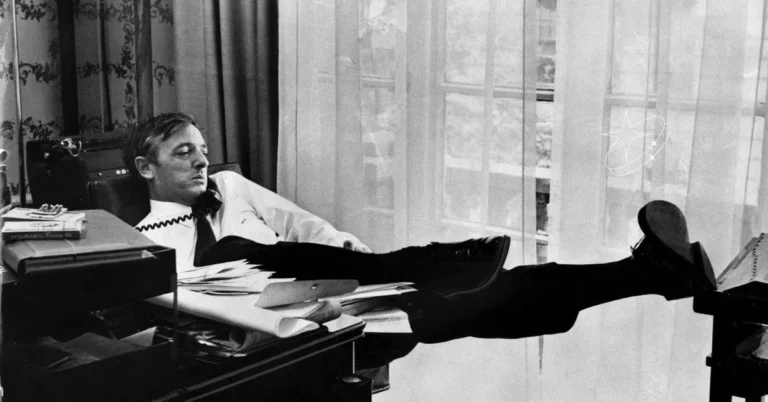
By contrast, watch an old episode of Firing Line and what will strike you won’t be the politics as much as the manner of engagement. Buckley is sharp, even merciless, but he is also genuinely engaged. He finds his opponent’s best arguments and takes them seriously enough to actually refute them. Buckley argued patiently, ironically, and with a kind of intellectual confidence that now feels almost foreign to modern political media. That gap is a philosophical collapse, one that Buckley spent his life trying to prevent.
Consider Buckley’s approach towards his greatest adversary, Gore Vidal. He was a man who disagreed with him on nearly everything, however, even after a bitter personal exchange during their 1968 debates, Buckley could still, according to biographer Sam Tanenhaus, refer to Vidal as ‘a great writer.’ By contrast, according to Vidal’s biographer, Fred Kaplan, he rarely mentioned Buckley, except to disparage him. This distinction matters. Buckley separated the man he was angry with from the writer he respected.
Buckley approached debate this way because he believed ideas mattered and that truth could be discerned through ‘honest intellectual combat.’ This principle formed both National Review and his Firing Line program. National Review wasn’t merely a platform for attacking liberals, it was a space where conservatives could refine their own ideas. Meanwhile Firing Line was a platform that brought ideas face-to-face. It was an opportunity for viewers to see conservative and liberal arguments challenging each other, giving the viewers a chance to sharpen their own thinking and leaving judgment to them. The leading point was that ideas could only thrive when debated in good faith.
That philosophy is almost entirely lost in today’s political media. While Buckley was determined to seek truth through honest debate, modern media seeks engagement through performance. The goal is no longer to challenge the audience but to confirm what it already believes, to signal tribal loyalty rather than advance a serious argument. How this happened, and what it cost conservatism specifically, is worth examining.
The economics of the modern media made this almost inevitable. Cable news discovered that outrage was more profitable than real argument, that viewers were more likely to keep watching if they weren’t being genuinely challenged. Beyond cable news, social media accelerated these dynamics. Algorithms reward controversy, emotional intensity, and tribal provocation, and eschew nuance and careful reasoning. A post that sharply confirms what the viewer already believes gets amplified. Over time, the incentives reshaped the product entirely. Editorial gatekeeping, which once forced writers and broadcasters to slow down and actually get things right, fell under the pressure of the twenty-four-hour news cycle. There is no longer time for the kind of patient, intellectual argumentation that Buckley modeled. Speed killed seriousness, and the market rewarded that.
In this regard, conservatism lost more painfully, as it had more to lose. The American right had built, by the mid-twentieth century, a genuine intellectual framework and a great network of thinkers who argued seriously and deeply on first principles, constitutional order, and the nature of the good society. Conservatism, being a framework rooted deeply in philosophical and historical truth, did not lose its infrastructure overnight. Talk radio, and then cable news offered a mass audience, as never experienced before. However, this came at a price, and the price was intellectualism itself. The new media was more interested in mobilizing a base. It led to tribal loyalty becoming the defining virtue of the movement.
Buckley himself had warned against this. In his book God and Man at Yale, he argues against, what he calls, ‘laissez-faire education,’ that is, against the idea that all values and ideas should be treated as equally valid, thus leaving students with no serious foundation. Media, especially conservative media, fell right into this trap. In abandoning the serious argumentative approach, it adopted a laissez-faire journalism, not by treating all values as equal, but by treating the question of truth as irrelevant altogether. The question stopped being “is this argument true?” and started being “is this person on our side?”
National Review explicitly states the magazine’s policy as rejecting “the hypodermic approach to world affairs.” Hence, its main purpose, even at its founding in 1955, was to seriously present the conservative case, to such a degree that it could not be ignored. Because of Buckley’s belief in the truth of conservatism, he wasn’t afraid to confront opposing views. If only one lesson is to be taken from this, it is that if a political tradition were to take its foundation for granted and were to stop arguing its first principles, it would eventually stop having any. Conservatism needs to get back to being interpreted, especially by the media, as a set of living ideas, as a tradition needing to be understood. It is precisely this conviction that set National Review apart from a party organ, and it is what makes it distinct still in contemporary times.
Having grown up in Montenegro, a country whose lack of genuine ideological debate and national populism led to quasi-tribal loyalty, I am writing this as an outsider of American political culture. The stakes of serious political journalism are not abstract to me. I have seen firsthand what politics looks like when ideas stop mattering, especially in a multiethnic country such as Montenegro. Looking up to American political culture as exemplary of what serious self-government can look like, I understand what is at stake when that culture stops taking its own ideas seriously. Buckley understood it too. That is why his magazine still matters, and why the argument he started still needs to be made.